DiatomBase
WoRMS name details
Rhizosolenia hebetata f. semispina (Hensen) Gran, 1908
149071 (urn:lsid:marinespecies.org:taxname:149071)
uncertain > unassessed
Forma
marine
(of Rhizosolenia semispina Hensen, 1887) Hensen, V. (1887). Uber die Bestimmung des Plankton's oder des im Meere treibenden Materials an Pflanzen und Thieren. Funfter Bericht der Kommission zur Wissenschaftliche Untersuchung der deutschen Meere in Kiel, fur die Jahre 1882-1886., 5: 1-108.
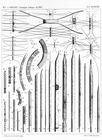
page(s): p. 84; pl. 5, fig. 39 [details]
page(s): p. 84; pl. 5, fig. 39 [details]
Kociolek, J.P.; Blanco, S.; Coste, M.; Ector, L.; Liu, Y.; Karthick, B.; Kulikovskiy, M.; Lundholm, N.; Ludwig, T.; Potapova, M.; Rimet, F.; Sabbe, K.; Sala, S.; Sar, E.; Taylor, J.; Van de Vijver, B.; Wetzel, C.E.; Williams, D.M.; Witkowski, A.; Witkowski, J. (2025). DiatomBase. Rhizosolenia hebetata f. semispina (Hensen) Gran, 1908. Accessed through: World Register of Marine Species at: https://www.marinespecies.org/aphia.php?p=taxdetails&id=149071 on 2025-07-05
Date
action
by
2005-03-30 08:52:46Z
created
db_admin
2018-01-31 09:33:29Z
changed
db_admin
2018-02-01 09:09:54Z
changed
db_admin
 The webpage text is licensed under a Creative Commons
Attribution 4.0 License
The webpage text is licensed under a Creative Commons
Attribution 4.0 License
Nomenclature
original description
(of Rhizosolenia semispina Hensen, 1887) Hensen, V. (1887). Uber die Bestimmung des Plankton's oder des im Meere treibenden Materials an Pflanzen und Thieren. Funfter Bericht der Kommission zur Wissenschaftliche Untersuchung der deutschen Meere in Kiel, fur die Jahre 1882-1886., 5: 1-108.
page(s): p. 84; pl. 5, fig. 39 [details]
basis of record Muylaert, K.; Sabbe, K. (1999). Spring phytoplankton assemblages in and around the maximum turbidity zone of the estuaries of the Elbe (Germany), the Schelde (Belgium/The Netherlands) and the Gironde (France). <i>J. Mar. Syst. 22</i>: 133-149 (look up in IMIS) [details]
new combination reference Gran, H.H. (1908). Diatomeen. Nordisches Plankton, Botanischer Teil, XIX, K. Brandt & C. Apstein (eds), Verlag von Lipsius und Fischer, Kiel und Leipzig, 146 pp.
page(s): p. 55; fig. 67 b [details]
page(s): p. 84; pl. 5, fig. 39 [details]
basis of record Muylaert, K.; Sabbe, K. (1999). Spring phytoplankton assemblages in and around the maximum turbidity zone of the estuaries of the Elbe (Germany), the Schelde (Belgium/The Netherlands) and the Gironde (France). <i>J. Mar. Syst. 22</i>: 133-149 (look up in IMIS) [details]
new combination reference Gran, H.H. (1908). Diatomeen. Nordisches Plankton, Botanischer Teil, XIX, K. Brandt & C. Apstein (eds), Verlag von Lipsius und Fischer, Kiel und Leipzig, 146 pp.
page(s): p. 55; fig. 67 b [details]
Other
context source (Deepsea)
Intergovernmental Oceanographic Commission (IOC) of UNESCO. The Ocean Biogeographic Information System (OBIS), available online at http://www.iobis.org/ [details]
context source (HKRMS) Lam CWY. & Ho KC. (1988). Phytoplankton characteristics of Tolo Harbour. In: Morton B, editor. Asian Marine Biology 6. pp 5-18. Hong Kong University Press, Hong Kong. [details]
context source (RAS) Australian Antarctic Data Centre. , available online at https://data.aad.gov.au/aadc/biodiversity/ [details]
additional source Tomas, C.R. (Ed.). (1997). Identifying marine phytoplankton. Academic Press: San Diego, CA [etc.] (USA). ISBN 0-12-693018-X. XV, 858 pp., available online at http://www.sciencedirect.com/science/book/9780126930184 [details]
additional source Hällfors, G. (2004). Checklist of Baltic Sea Phytoplankton Species (including some heterotrophic protistan groups). <em>Baltic Sea Environment Proceedings.</em> No. 95: 210 pp., available online at http://helcom.fi/Lists/Publications/BSEP95.pdf [details] Available for editors [request]
additional source Fourtanier, E. & Kociolek, J. P. (compilers). (2011). Catalogue of Diatom Names. California Academy of Sciences, On-line Version. Updated 2011-09-19., available online at http://researcharchive.calacademy.org/research/diatoms/names/index.asp [details]
additional source Liu, J.Y. [Ruiyu] (ed.). (2008). Checklist of marine biota of China seas. <em>China Science Press.</em> 1267 pp. (look up in IMIS) [details] Available for editors [request]
additional source Lakkis, S. (2011). Le phytoplancton marin du Liban (Méditerranée orientale): biologie, biodiversité, biogéographie. Aracne: Roma. ISBN 978-88-548-4243-4. 293 pp. (look up in IMIS) [details]
additional source Harper, M.A.; Cassie Cooper, V.; Chang, F.H.; Nelson, W.A.; Broady, P.A. (2012). Phylum Ochrophyta: brown and golden-brown algae, diatoms, silicoflagellates, and kin, in: Gordon, D.P. (Ed.) (2012). New Zealand inventory of biodiversity: 3. Kingdoms Bacteria, Protozoa, Chromista, Plantae, Fungi. pp. 114-163. [details]
context source (HKRMS) Lam CWY. & Ho KC. (1988). Phytoplankton characteristics of Tolo Harbour. In: Morton B, editor. Asian Marine Biology 6. pp 5-18. Hong Kong University Press, Hong Kong. [details]
context source (RAS) Australian Antarctic Data Centre. , available online at https://data.aad.gov.au/aadc/biodiversity/ [details]
additional source Tomas, C.R. (Ed.). (1997). Identifying marine phytoplankton. Academic Press: San Diego, CA [etc.] (USA). ISBN 0-12-693018-X. XV, 858 pp., available online at http://www.sciencedirect.com/science/book/9780126930184 [details]
additional source Hällfors, G. (2004). Checklist of Baltic Sea Phytoplankton Species (including some heterotrophic protistan groups). <em>Baltic Sea Environment Proceedings.</em> No. 95: 210 pp., available online at http://helcom.fi/Lists/Publications/BSEP95.pdf [details] Available for editors
[request]additional source Fourtanier, E. & Kociolek, J. P. (compilers). (2011). Catalogue of Diatom Names. California Academy of Sciences, On-line Version. Updated 2011-09-19., available online at http://researcharchive.calacademy.org/research/diatoms/names/index.asp [details]
additional source Liu, J.Y. [Ruiyu] (ed.). (2008). Checklist of marine biota of China seas. <em>China Science Press.</em> 1267 pp. (look up in IMIS) [details] Available for editors
[request]additional source Lakkis, S. (2011). Le phytoplancton marin du Liban (Méditerranée orientale): biologie, biodiversité, biogéographie. Aracne: Roma. ISBN 978-88-548-4243-4. 293 pp. (look up in IMIS) [details]
additional source Harper, M.A.; Cassie Cooper, V.; Chang, F.H.; Nelson, W.A.; Broady, P.A. (2012). Phylum Ochrophyta: brown and golden-brown algae, diatoms, silicoflagellates, and kin, in: Gordon, D.P. (Ed.) (2012). New Zealand inventory of biodiversity: 3. Kingdoms Bacteria, Protozoa, Chromista, Plantae, Fungi. pp. 114-163. [details]
 Present Present in aphia/obis/gbif/idigbio Inaccurate Introduced: alien Containing type locality